Every template on this page was designed and maintained in-house by uiCookies — a small, deliberate collection of our own travel and tourism work, not a scraped roundup of other people's demos. Because we build and support them ourselves, each one is consistent, current, and honest about exactly what it does.
A travel site has to do two jobs at once: sell the feeling of a place with big, confident photography, and handle the logistics that turn a daydream into a booking — dates, prices, itineraries, difficulty, and trust signals. The best ones commit to one side of that line. Inspiration-led guides and blogs lead with story and a destination search; conversion-led agency and expedition sites lead with scannable trip cards and a clear path to enquire. This collection gives you a clean starting point for either.
All of them are free to download and use, built on Bootstrap 5 with plain vanilla JavaScript and zero jQuery, and each ships with a live demo and a direct download — no email wall, no build step, and no framework to learn.
The templates
Places
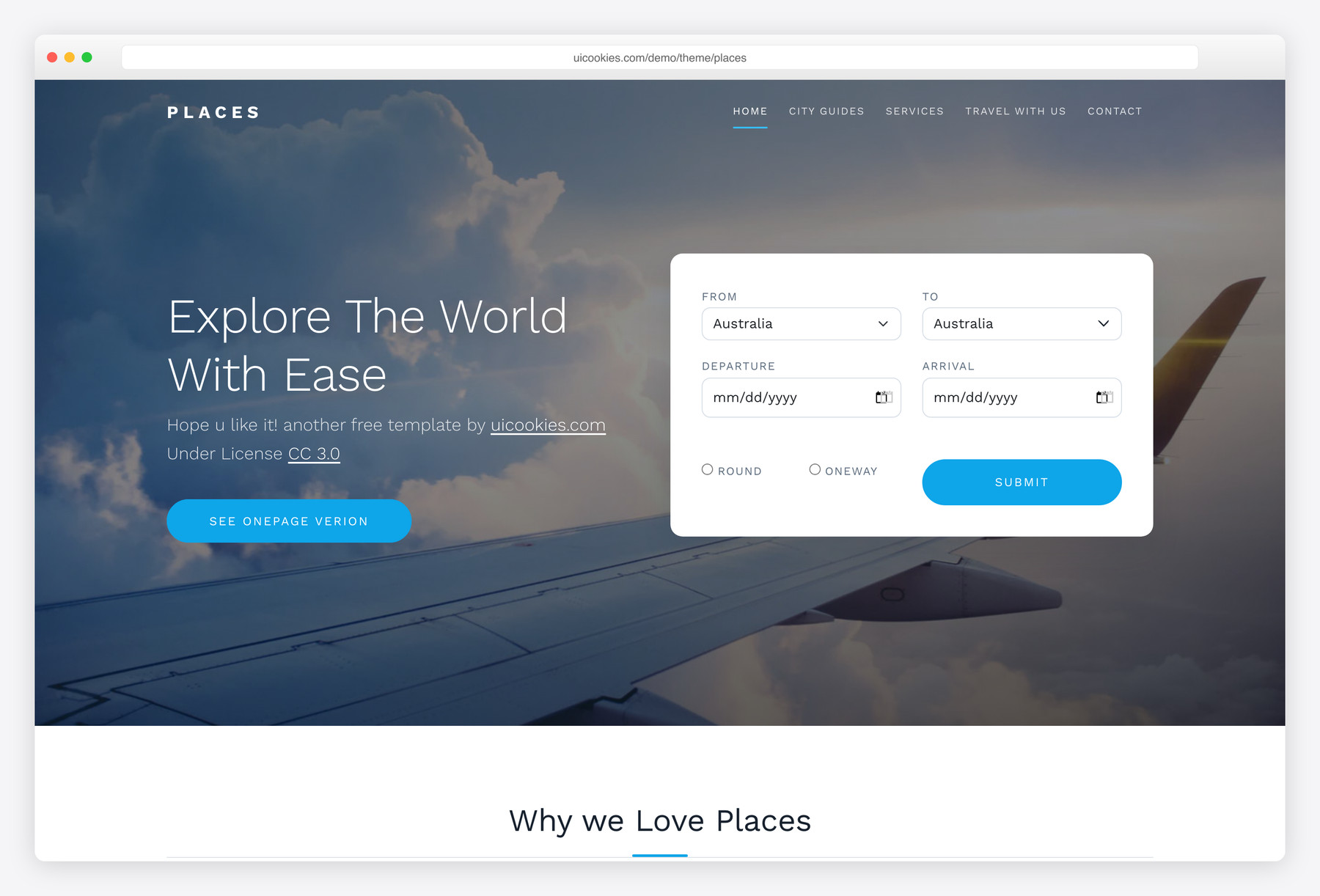
The only complete multi-page site in this collection: Places ships six ready-made pages — home, tours, city guides, a booking-style layout, about, and contact — that map to the whole customer journey rather than a single landing screen. It's built for established travel agencies and tour operators who need a full website out of the box, with destination guides and a tours page structured for browsing and enquiry. Bootstrap 5 and jQuery-free throughout, so it stays fast and simple to hand off to a client.
Voyage
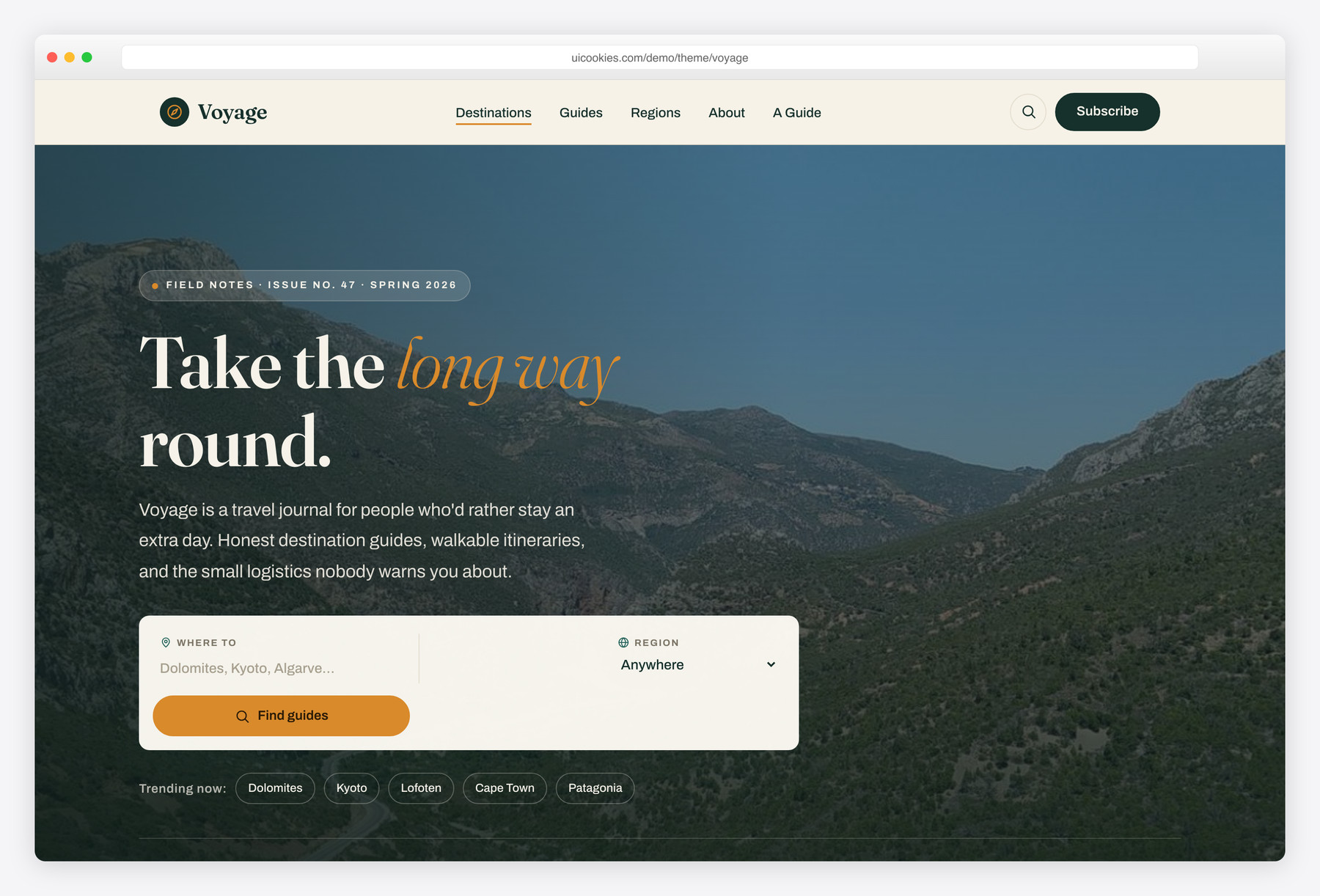
Voyage is the storytelling option — it opens with a destination search and a magazine-style featured grid instead of a booking widget, and it carries a full day-by-day guide page for long-form itineraries. That makes it right for travel bloggers, destination guides, and tourism content sites that earn their living from an audience rather than a checkout. Its deep-fir-green and golden-ochre palette with a Fraunces display face gives long travel writing a printed-journal warmth most templates can't match.
Compass
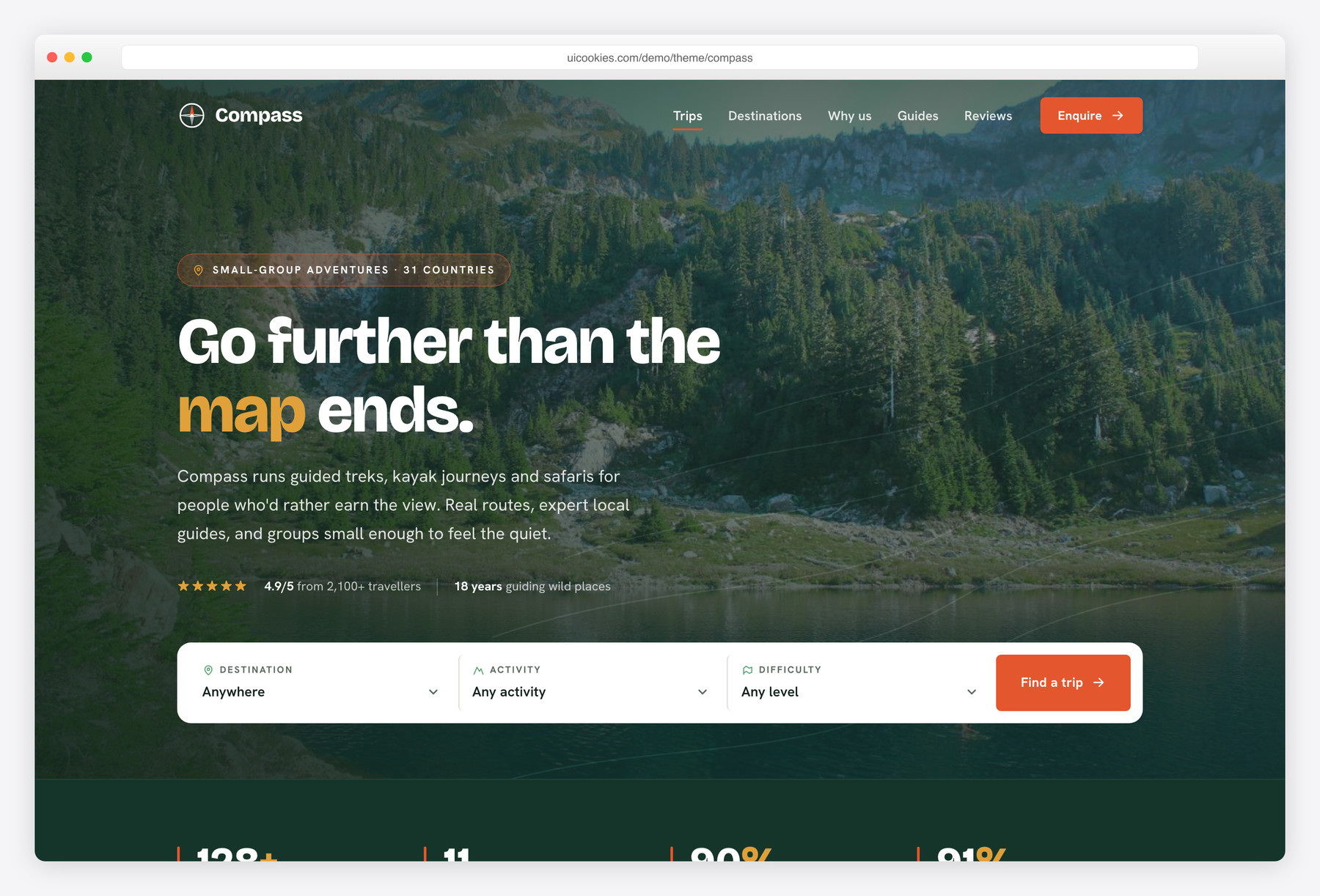
Compass turns a trip catalogue into something scannable: every card in its featured-trips grid carries a colour-coded difficulty badge alongside duration, group cap, price, and rating, so visitors compare real expeditions at a glance the way they'd read a trek brochure. It's aimed squarely at adventure outfitters and expedition companies selling defined departures, not open-ended package holidays. A hero trip-finder, a three-step booking flow, a guides team section, and an enquiry form round out the journey — all on Bootstrap 5 with zero jQuery.
Compare at a glance
| Template | Best for | Layout | Standout feature |
|---|---|---|---|
| Places | Travel agencies & tour operators | Full six-page agency site | City guides + booking-style tours across a complete multi-page structure |
| Voyage | Travel blogs & destination guides | Magazine-style multi-page editorial | Day-by-day itinerary page + printed-journal look (Fraunces) |
| Compass | Adventure & expedition outfitters | Trip-finder landing + booking flow | Difficulty / duration / price / rating trip cards + 3-step booking |
How to choose
Start by matching the template to your business model, because the three barely overlap in intent. Voyage is inspiration-led — pick it if you publish destination guides or stories and monetise an audience. Places is the full-agency choice — pick it if you sell many tours and need a complete multi-page site with city guides and a proper about and contact structure. Compass is conversion-led for a defined catalogue — pick it if people compare your trips by difficulty, dates, and price before they commit. Putting a blog template behind a booking business, or a rigid trip grid in front of a content site, creates friction your visitors feel immediately.
Then weigh the features that actually matter in travel. Imagery is the product here, so favour a template that handles big photography responsibly — responsive images, controlled aspect ratios, and lazy loading — because an unoptimised hero photo is the single fastest way to wreck load time and Core Web Vitals on an image-heavy page. Look for a search or filter above the fold and cards that surface the practical facts (price, dates, duration, difficulty), not just a pretty photo; vagueness is what kills travel conversions, which is exactly why Compass front-loads structured trip metadata and Voyage leads with a destination search. Make sure there's room for the detail travellers demand — day-by-day itineraries, maps, seasonal pricing, and real review or guide trust signals — and be wary of jQuery-era carousels and lightboxes that bloat the page. Everything here is vanilla JavaScript, so there's far less to slow down or break.
Finally, plan for booking and hosting up front. These are static Bootstrap 5 front-ends you edit directly — swap palette, copy, and photography in an afternoon with no build step — but availability, payments, and real reservations are not built in. Treat the template as your storefront and wire the actual booking to a proper backend: a booking engine or channel manager, a headless CMS or WordPress if editors need to publish new destinations (Voyage in particular slots neatly onto a blog CMS), and an enquiry form that posts to your inbox or a form service. Never collect card details through a plain static form. Before launch, compress and convert your images to AVIF or WebP — on travel sites that's the main performance lever — serve over HTTPS, and run a quick contrast and focus-state pass, since text set over full-bleed photos is a common accessibility failure.
Frequently asked questions
Are these really free, and can I use them for a commercial travel business?
Yes. Every template here is free to download and use, including on commercial agency, tour-operator, and client sites — there's no per-project fee and no attribution required on the page.
Can I edit them without npm, a build tool, or a framework?
Yes. They're plain HTML with Bootstrap 5 CSS and vanilla JavaScript, so you open the files, change copy, colours, and photos, and refresh the browser. Nothing needs to compile.
Are they responsive and mobile-first?
Yes — all three are built on the Bootstrap 5 grid and tested down to small phones. That matters in travel, where a large share of destination research and booking happens on mobile, so cards and itineraries reflow rather than overflow the screen.
Can I take real bookings and payments through these?
Not out of the box — they're static front-ends, so you point the enquiry and booking forms at your own backend or embed a booking widget or engine. Never collect card details through a plain static form; route real payments through a secure, PCI-compliant service.
Can I connect one to a CMS so I can keep publishing destinations and guides?
Yes. They pair with any stack — WordPress, a headless CMS, or your own framework — and Voyage in particular is built for a blog-style CMS so writers can add guides and itineraries without touching the layout.
Will all the photography slow the site down?
It doesn't have to. The templates are jQuery-free and lazy-load below-the-fold images, but the biggest lever is on you: compress and convert your hero and gallery photos to AVIF or WebP at the right dimensions, since travel pages are unusually image-heavy.
Related templates
Free Hotel & Resort Website Templates · Free Restaurant Website Templates · All free HTML website templates