This page has two halves. First, nine portfolio and résumé templates designed and maintained in-house by uiCookies — free to download, live to preview, and editable in any code editor with no build step and no signup. Then four open-source portfolios from GitHub that we rate but did not build, for when a different stack or approach suits you better.
Our own templates are built on Bootstrap 5 (Atelier on the Bootstrap 6 alpha) with no jQuery, so they load fast, stay responsive, and are simple to customise. Swap the placeholder text and images and you have a personal site or online CV ready to publish anywhere.
Our templates
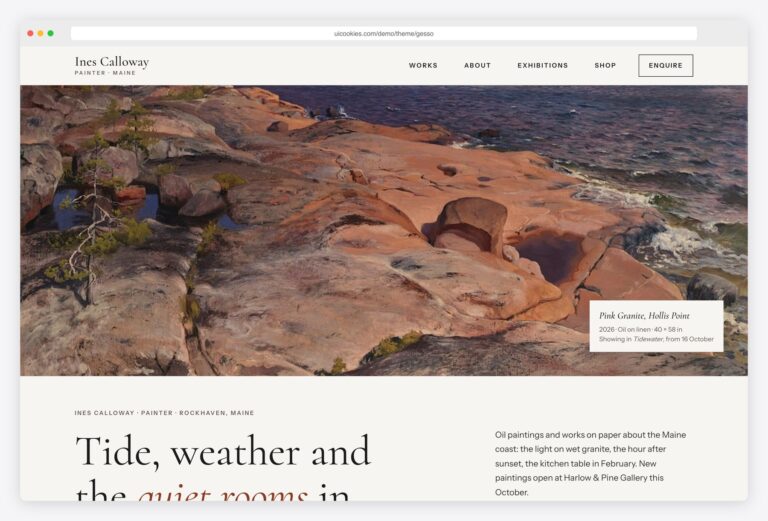
Gesso
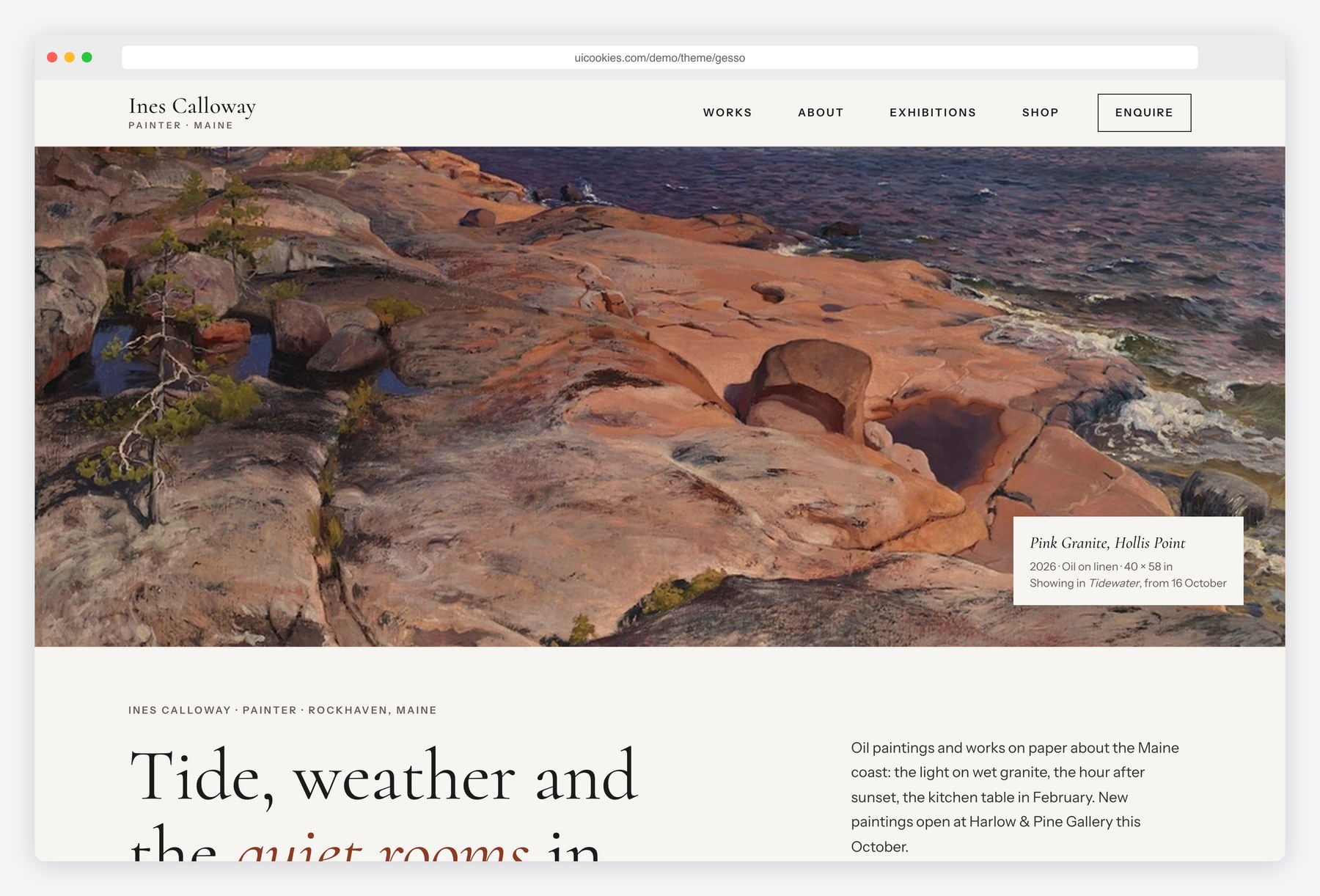
Gesso is for painters and fine artists who sell originals directly, a portfolio that keeps the design quiet so the paintings carry the page; the demo belongs to a fictional painter in Maine. Across four pages it covers a home page with a full-bleed painting and wall-label caption, the current series and an upcoming exhibition; a works page that filters twelve works by series, medium and year; an about page with a biography, artist statement and printable CV of shows, residencies and collections; and a shop for originals and limited prints with a commission enquiry form. A gallery representing one artist could use it as well.
Each work opens in a native dialog lightbox with its dimensions, availability and price, and gallery-style red dots mark works as available, sold or on loan. An Enquire button carries the painting and a matching budget range into the form, and the exhibition block builds an .ics calendar file in the browser. The form only validates until you connect a service. Bootstrap 5, vanilla JavaScript, no jQuery.
Linework
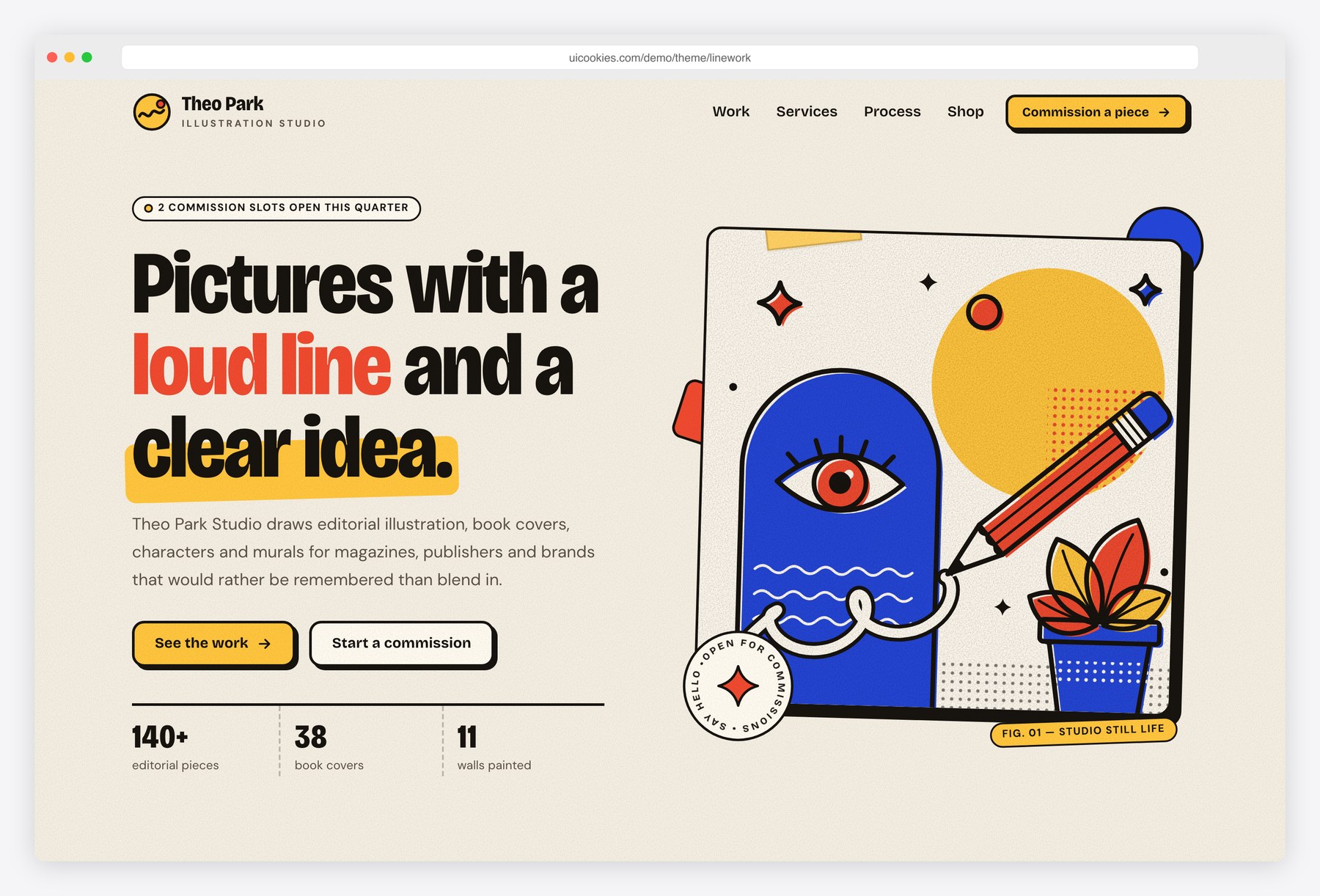
Linework suits illustrators and graphic artists who take commissions, from editorial pieces and book covers to characters and murals. The demo studio's home page leads with a large illustrated hero, then selected projects, client wordmarks, services with starting prices, a brief-sketches-final process strip and a testimonial. A projects page filters nine case studies by discipline, each opening in a dialog, and a commissions page combines a three-month availability calendar, a brief form, a shop strip for prints, a zine and stickers, and an FAQ.
Almost all of the artwork is inline SVG in one style, and each case study sets the final piece beside a blue-pencil rough and an in-use mock-up. Changing the palette custom properties recolours every illustration. The brief form takes reference files by drag and drop, but they stay on the visitor's device and nothing is sent until you connect a form service. Bootstrap 5, vanilla JavaScript, no jQuery.
Byline
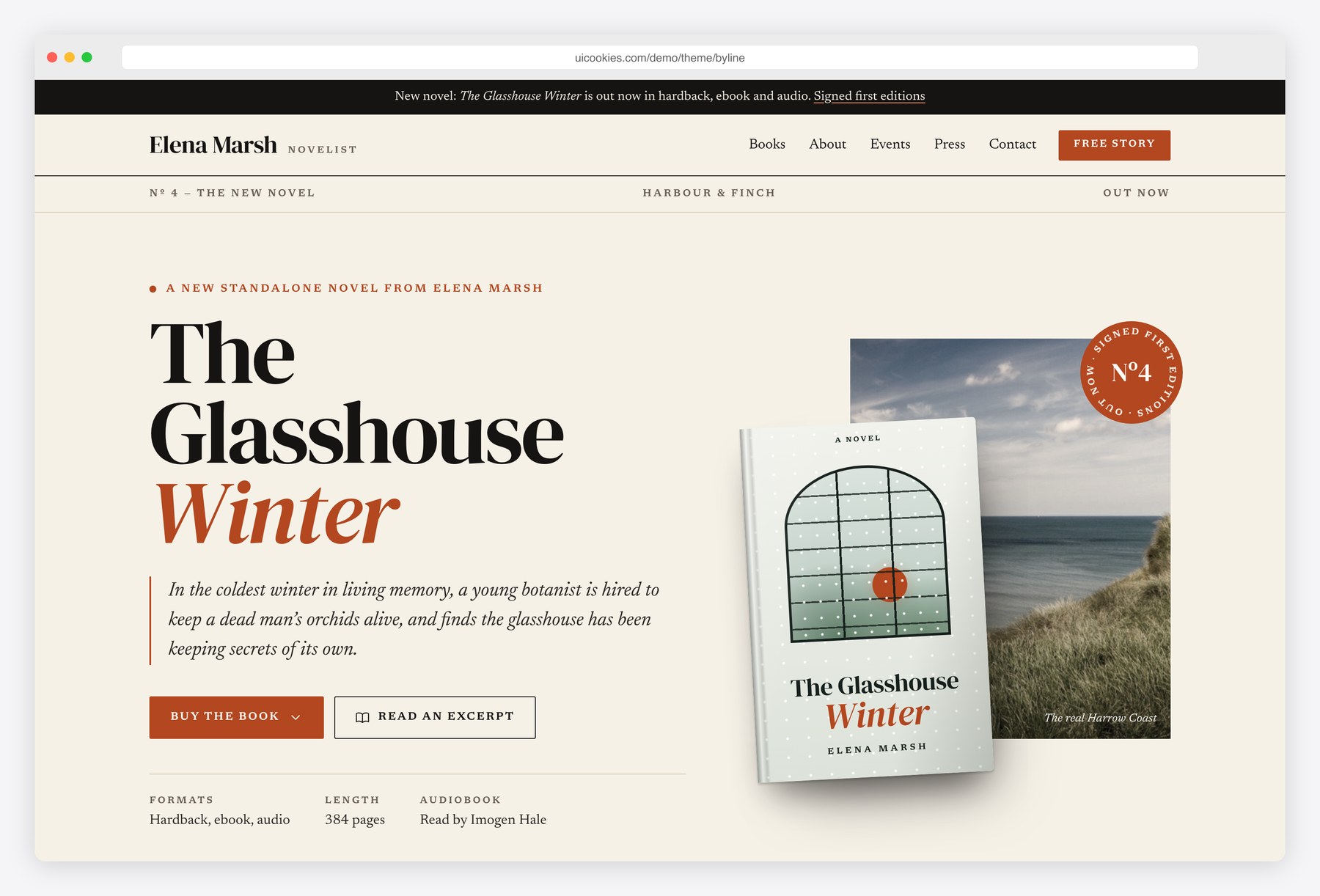
Byline brings the portfolio idea to fiction writers: an author site set up for the fictional novelist Elena Marsh, with a three-book series and a standalone novel. The home page puts the latest book in the hero with a retailer menu, then praise quotes, the books row, an about section, tour dates that switch between upcoming and past, a newsletter sign-up offering a free short story, and contact options. A bibliography page groups titles by series with reading order, formats and retailer buttons, and a press kit page serves journalists with bios, assets and an interview.
The four book covers are designed in HTML and CSS, so retitling one means editing text rather than artwork. Excerpts open in a native dialog reader with reading progress and a larger-text toggle, and each press bio copies to the clipboard in one click. The newsletter and enquiry forms validate in the browser only. Bootstrap 5, vanilla JavaScript, no jQuery.
Atelier
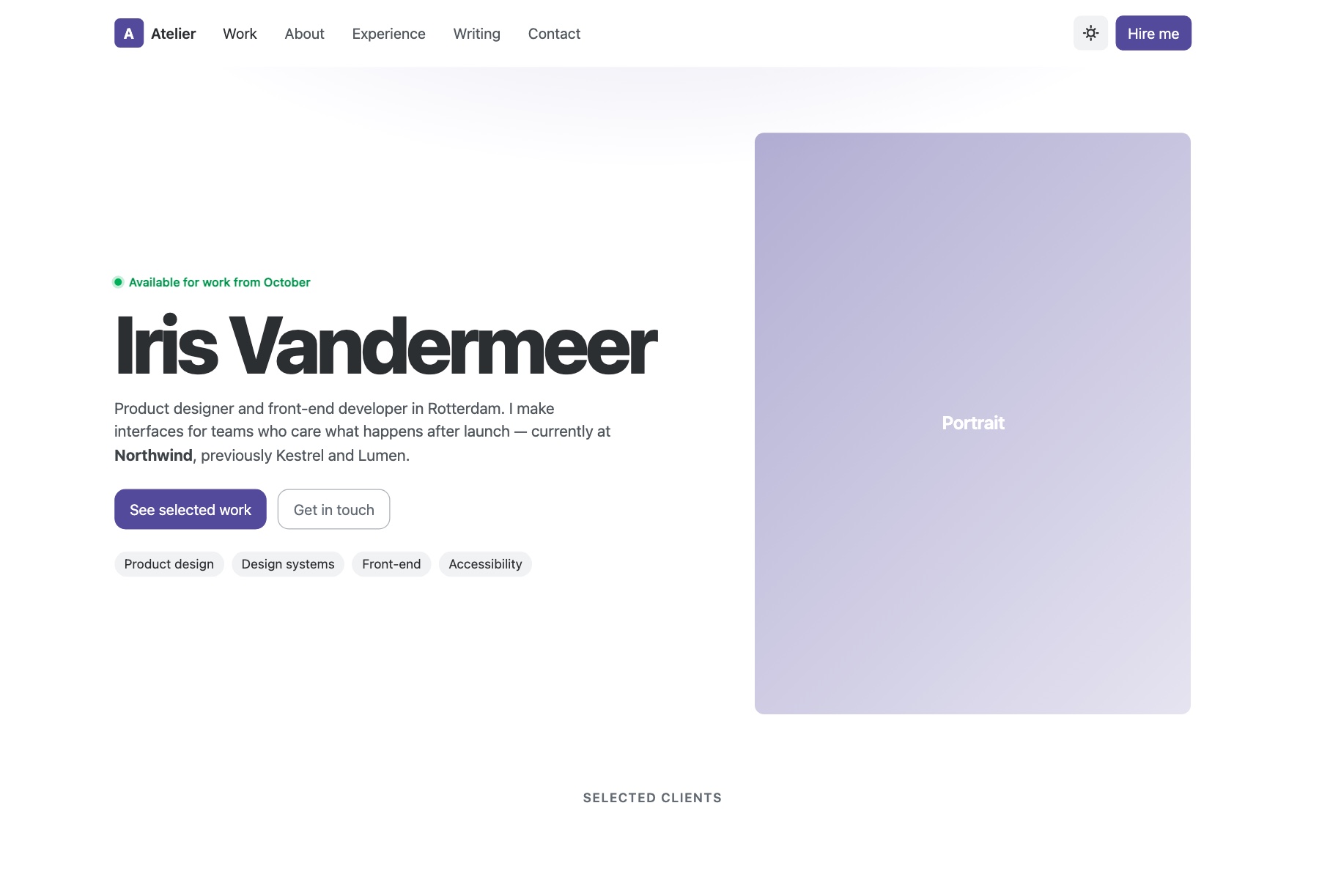
Atelier is a two-page portfolio for a designer, developer or freelancer who wants to show how a project was done, not only how it looks. Its landing page runs through selected work with hover states and project metadata, an about section, skill meters, an experience timeline, a writing section for notes and essays, and a contact form. The second page is a complete case study with sections for the problem, the approach, what changed and the result, plus result metrics and an at-a-glance summary rail that stays pinned as you read.
The contact form asks what a client brief needs: project type through a Combobox, a start date through a Datepicker, and budget on a Range slider that shows its value in a live bubble. It validates natively but sends nothing until connected. The mobile menu opens in a native dialog drawer and dark mode is remembered. Bootstrap 6 alpha, ESM-only vanilla JavaScript and no build step.
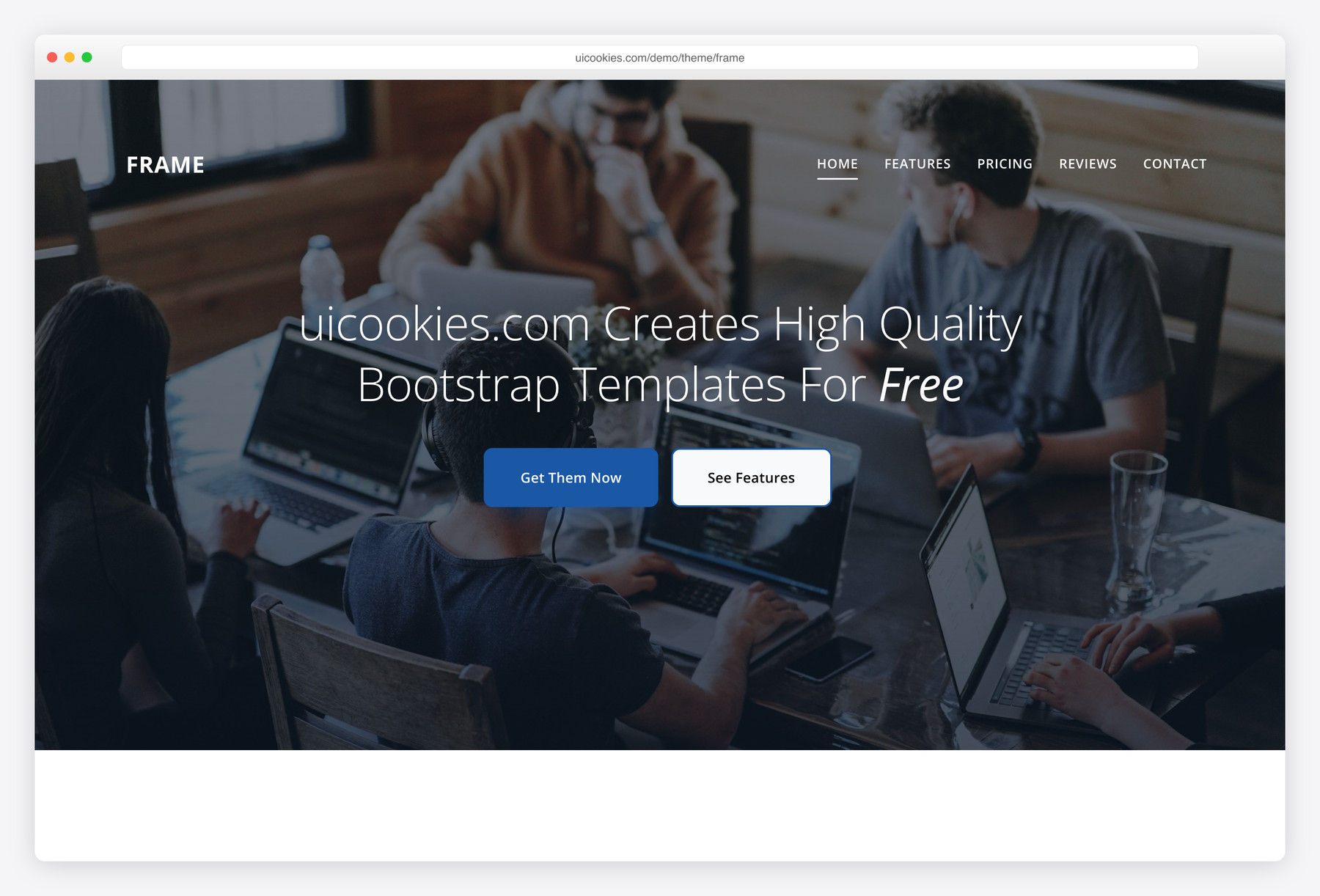
Frame
Frame is our most-downloaded template: a single-page layout that carries a hero, about, services, portfolio grid, and contact section on one smooth scroll. It is the fastest way to stand up a clean personal or one-page portfolio site.
The navigation scroll-spies as you move down the page, the portfolio grid filters by category, and every interaction is plain vanilla JavaScript — no jQuery, no page reloads.
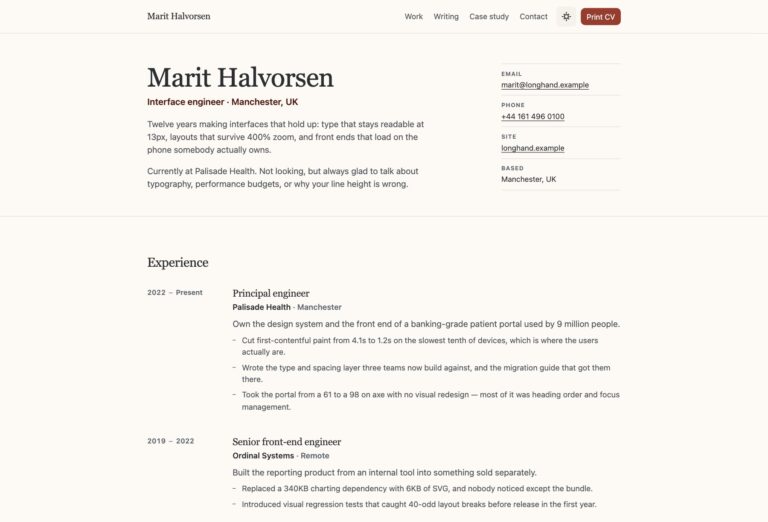
Online CV
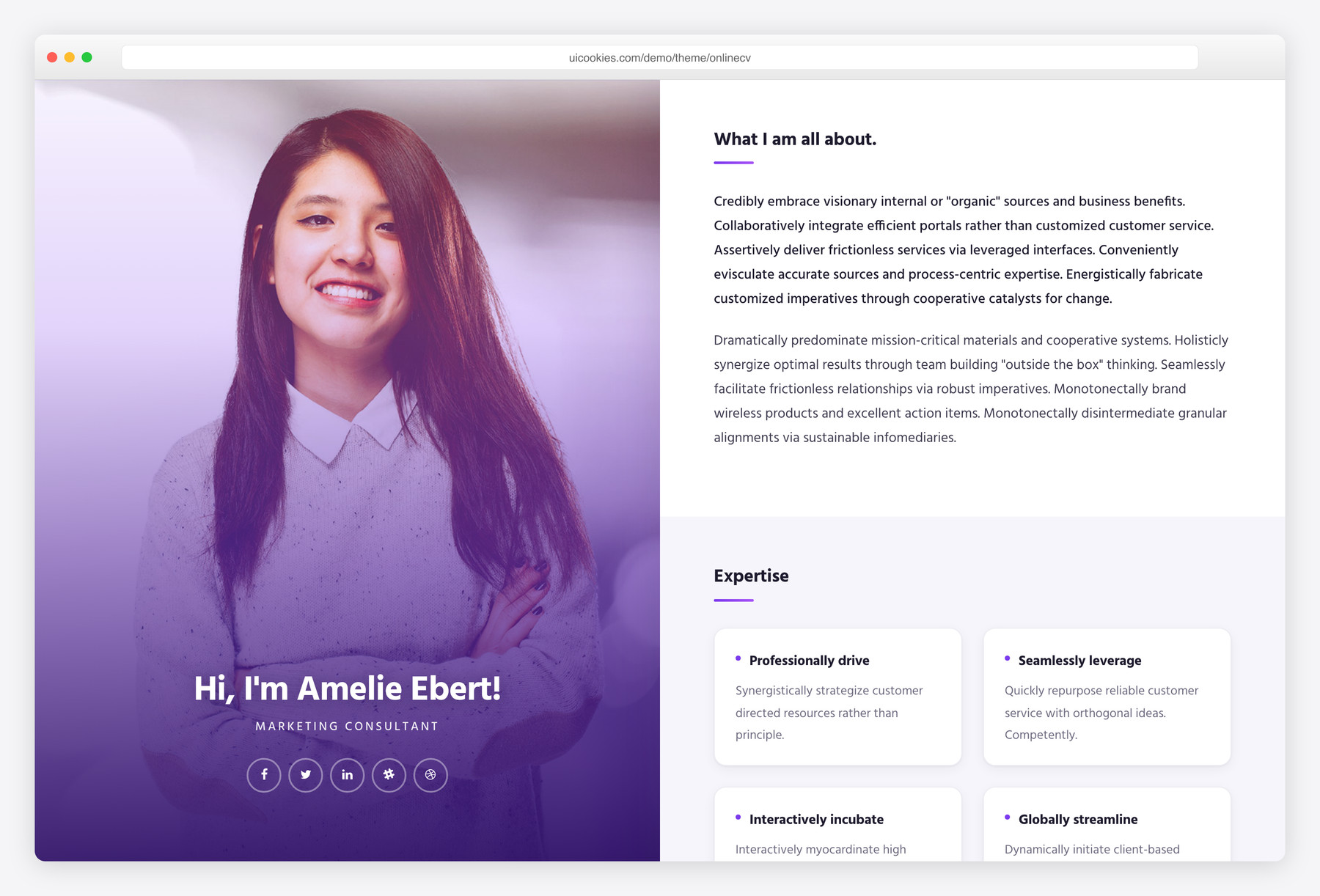
Online CV turns a traditional résumé into a proper web page: a fixed profile sidebar with your photo, contact details, and skill bars sits beside a main column for your experience timeline, education, and work samples.
It reads like a document but behaves like a site, which makes it a strong choice for a shareable online CV you can send instead of a PDF.
Resumex
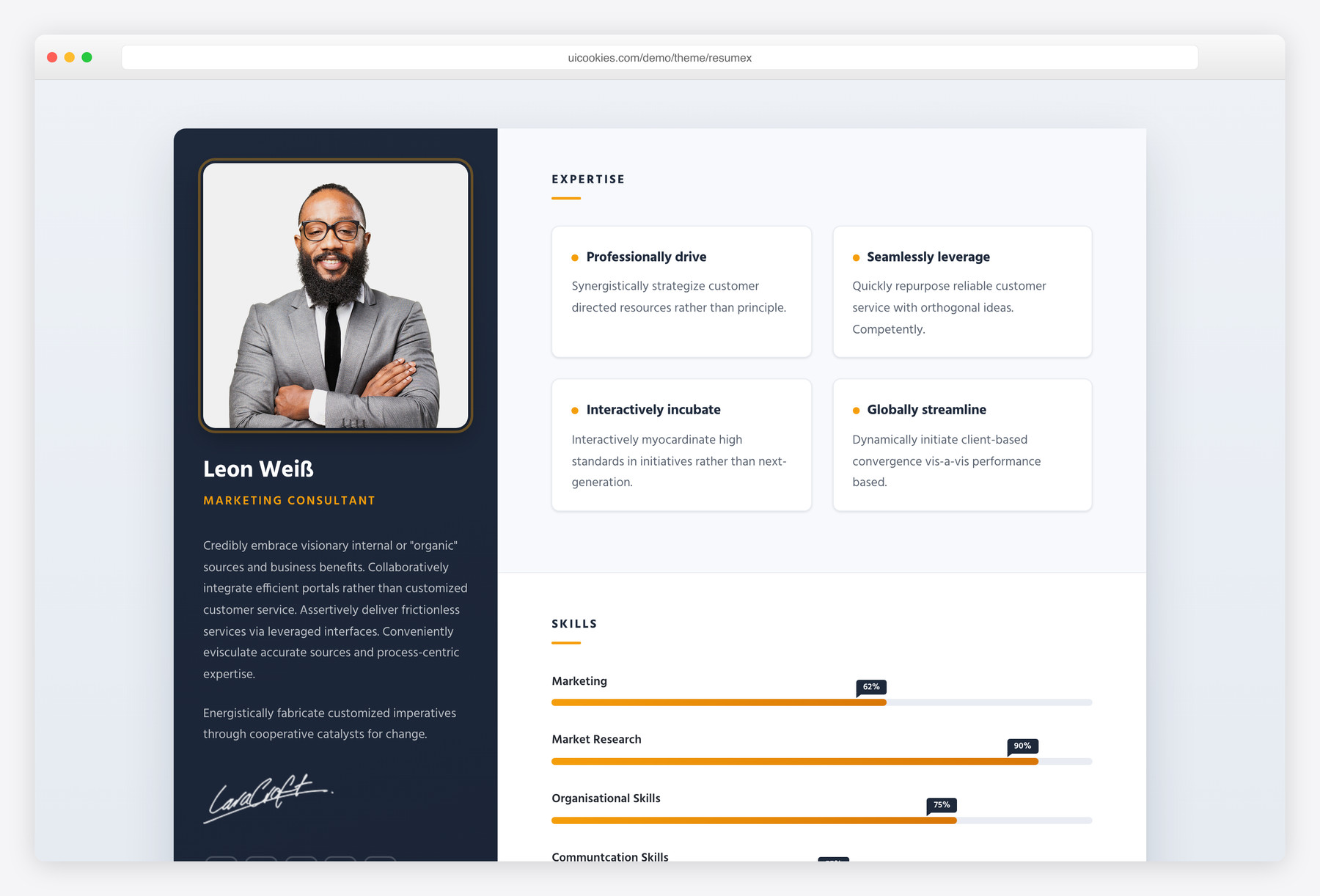
Resumex is a résumé-portfolio hybrid built for developers and designers. A sticky profile sidebar stays in view while the main column scrolls through animated skill meters, an experience and education timeline, and a project gallery.
The sticky behaviour is native CSS rather than a plugin, so it stays smooth on long pages and small screens alike.
Profile
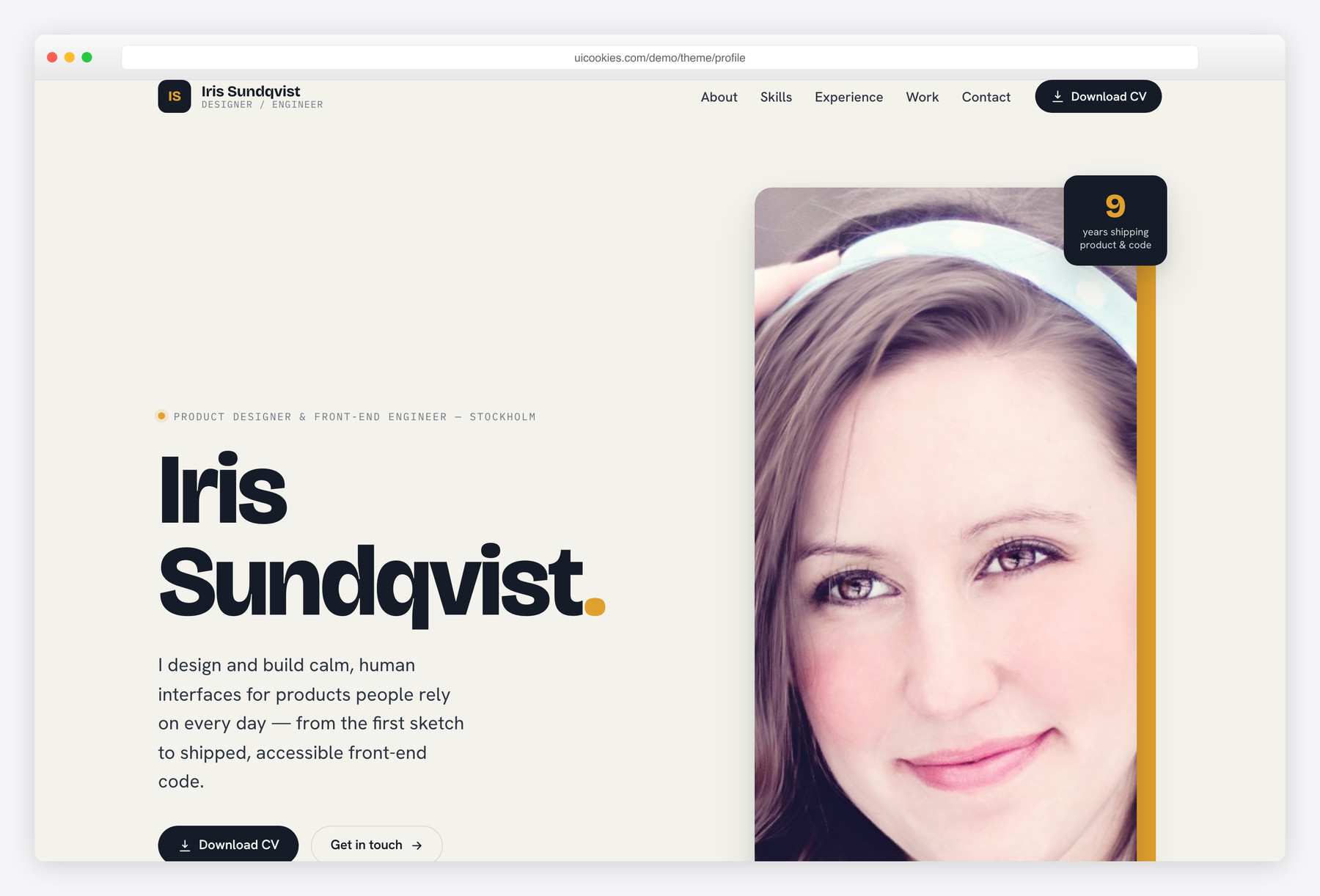
Profile is a single-page résumé and personal site for a working professional — a split hero, a skills section, an experience timeline, and a small portfolio grid, all on one clean scroll. Ideal for a shareable online CV that reads better than a PDF.
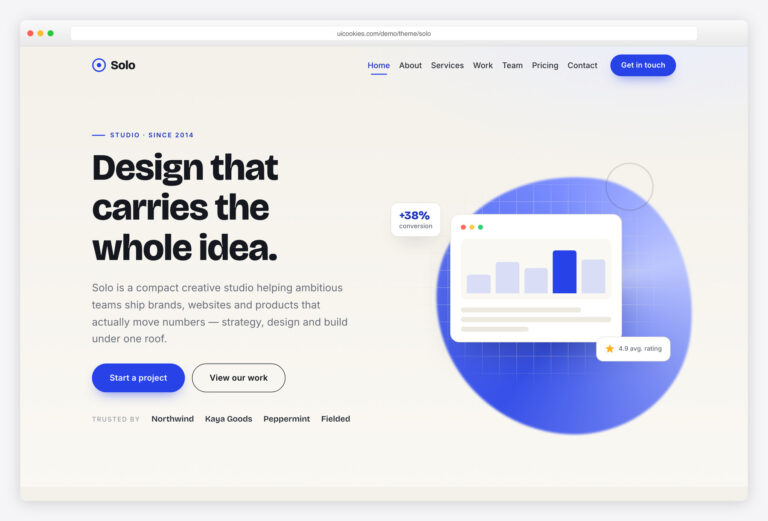
Persona
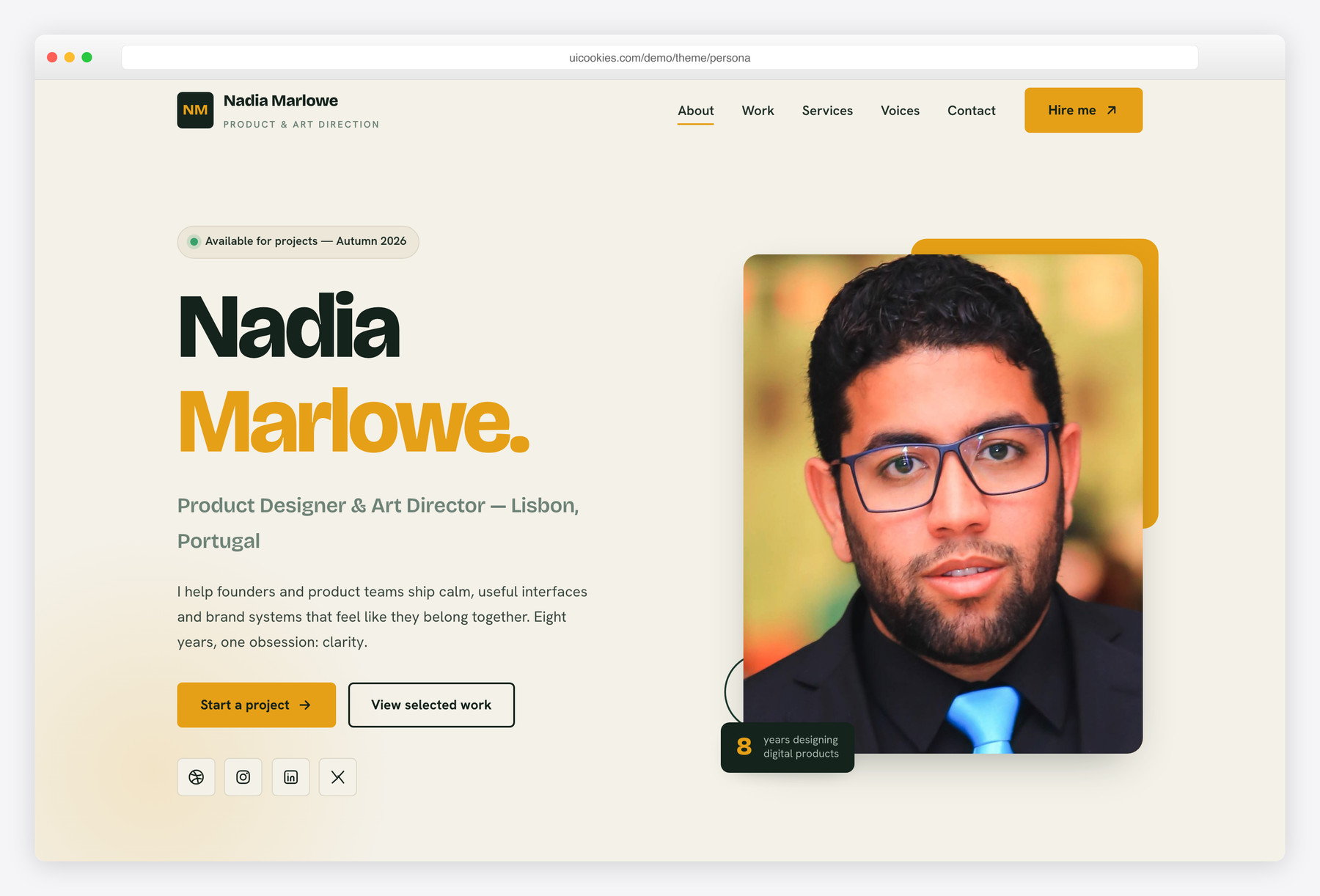
Persona is a freelancer and personal vCard site with a bold split hero, a services grid, a portfolio with hover overlays, and a testimonials slider. Personable and distinctive, it suits designers, developers, and creatives selling their own work.
Compare at a glance
| Template | Best for | Layout | Standout feature |
|---|---|---|---|
| Gesso | Painters / fine artists | Home, works, about/CV + shop | Filterable works + wall-label lightbox |
| Linework | Illustrators taking commissions | Home, projects + commissions page | SVG artwork with sketch roughs + availability calendar |
| Byline | Novelists / authors | Home, bibliography + press kit | Excerpt reader + copyable press bios |
| Atelier | Designer / developer case studies | Landing page + case-study page | Brief-style contact form with budget slider |
| Frame | One-page personal portfolio | Sectioned single page | Scroll-spy nav + filterable grid |
| Online CV | Shareable online résumé | Sidebar profile + main column | Skill bars and experience timeline |
| Resumex | Developer / designer CV | Sticky sidebar | Animated skill meters |
| Profile | Résumé / personal site | Split hero + timeline | Experience timeline |
| Persona | Freelancer / vCard | Split hero + portfolio | Testimonials slider |
Open-source portfolios worth a look
These four are not ours. They are MIT-licensed projects on GitHub that we checked in August 2026 — each one actively maintained, not archived, with a working live demo. We list them because a portfolio is personal, and the right starting point depends on how you like to work more than on who made the template. If you want to edit HTML directly, our templates and Portfolio HTML fit. If you would rather run a modern build, devportfolio is the better answer.
MIT licensing means you can use, change and publish them commercially, including for client work, as long as you keep the licence file. Because they are community projects rather than ours, support comes from their GitHub issues rather than from us.
Portfolio HTML
The closest match to our own templates: no framework, no build step, just HTML, CSS and JavaScript you can open and edit. It is maintained as a community project, so it keeps getting small fixes rather than being abandoned after launch. Pick this one if you want something familiar to edit but would rather start from a community codebase than ours.
Stack: Plain HTML, CSS & JavaScript · Licence: MIT · 675 stars on GitHub
Live demo · Source on GitHub
Simplefolio
The most-starred developer portfolio template on GitHub by a wide margin. It is a single scrolling page — hero, about, projects, contact — with SCSS source and a Parcel build. You get a compile step in exchange for tidier stylesheets, which is a fair trade if you already work that way.
Stack: SCSS + Parcel · Licence: MIT · 14.2k stars on GitHub
Live demo · Source on GitHub
devportfolio
A modern Astro and Tailwind build with a timeline layout for experience and skills. Astro ships almost no JavaScript by default, so this stays fast without much tuning. Choose it if you want a current stack and are comfortable running npm install.
Stack: Astro + Tailwind CSS · Licence: MIT · 4.9k stars on GitHub
Live demo · Source on GitHub
GitProfile
Different in kind from everything else here: instead of writing your own project list, you give it your GitHub username and it builds the portfolio from the API. Your repositories, languages and stars stay current on their own. The trade-off is less control over the page in exchange for never updating it again.
Stack: React + TypeScript · Licence: MIT · 2.3k stars on GitHub
Live demo · Source on GitHub
| Project | Stack | Best for | Stars |
|---|---|---|---|
| Portfolio HTML | Plain HTML, CSS & JavaScript | Editing by hand, zero tooling | 675 |
| Simplefolio | SCSS + Parcel | A proven, widely-used starting point | 14.2k |
| devportfolio | Astro + Tailwind CSS | A modern stack with great performance | 4.9k |
| GitProfile | React + TypeScript | A portfolio that maintains itself | 2.3k |
How to choose
Choosing between them comes down to what you are presenting. If you want a full personal site — work, services, and a way to get in touch — Frame gives you the most room. If the goal is a digital version of your résumé, Online CV and Resumex are both purpose-built for it; pick Online CV for a document-style layout and Resumex if you want the animated skills and project gallery.
Most are one-page templates, so there is little to wire up between pages. Start from the demo closest to your content, replace the copy and images, and adjust the accent colour in the stylesheet to match your brand.
Atelier is the pick when a case study matters more than a gallery: it pairs a personal landing page with a full write-up of one project, where Frame and Profile keep everything on one scroll. It runs on the Bootstrap 6 alpha, which targets recent browsers only, so choose one of the Bootstrap 5 templates above if you need a base that will not change under you.
Gesso, Linework and Byline cover creative work the templates above are not shaped for. Pick Gesso if you paint and sell originals and prints, Linework if you illustrate to commission and want a brief form and an availability calendar, and Byline if you write books and need a bibliography and a press kit. Where Atelier tells one project's story as a case study, these three are built around a body of work and how to buy, commission or read it. All three run on stable Bootstrap 5.
Frequently asked questions
Are these portfolio and resume templates free?
Yes. Every template here is free to download and use for personal and commercial projects. There is no signup, paywall, or trial — you get the full HTML, CSS, and JavaScript.
Do I need to know how to code to use them?
A little HTML helps, but you do not need to write code from scratch. The files are plain HTML and CSS, so you can open them in any editor, change the text and images, and publish. Everything you edit is clearly laid out in the markup.
Are the templates mobile responsive?
Yes. Our templates all use responsive Bootstrap layouts, so they adapt to phones, tablets, and desktops without extra work.
Can I host my portfolio anywhere?
Yes. Because these are static HTML templates with no server-side code, you can host them on any web host, GitHub Pages, Netlify, Cloudflare Pages, or your own server.
Are the open-source templates on this page yours?
No. The templates in the first section are ours. The four under “Open-source portfolios worth a look” are MIT-licensed community projects hosted on GitHub — we verified their licence, activity and demos, but we did not build them and we cannot support them. Their GitHub issue trackers are the right place for questions about them.
Related templates
Photography website templates · All free HTML website templates · Free Personal Website Templates · Free Artist Website Templates · Free Book, Author & Bookstore Website Templates